Why smart glasses enthusiasts created AI Coding.Info ~Summary of AI Coding trends in August 2026 based on data~
author: @kotauchisunsun
Release date: 2026/09/29
AI Coding Agent trends in August 2026
We have been operating a site called AI Coding.Info since July 2025.
This is a site that observes usage trends related to AI Coding Agents such as Claude Code, Codex CLI, Github Copilot, and Gemini from a fixed point from information in Github repositories. To determine the use of AI Coding Agent, we conduct daily surveys under the following conditions.
- Daily inspection of 9,000 public repositories on Github
- TOP 300 Github stars by programming language
- Researched from 30 types of programming languages
- Targets 16 types of AI Coding Agents
- Only when the rule files used by various AI Coding Agents are in the Github repository, it is determined that AI Coding Agent is being used.
Last month's trends
https://ai-coding.info/reports/articles/20260812
AI Coding Agent usage rate is 13.9%
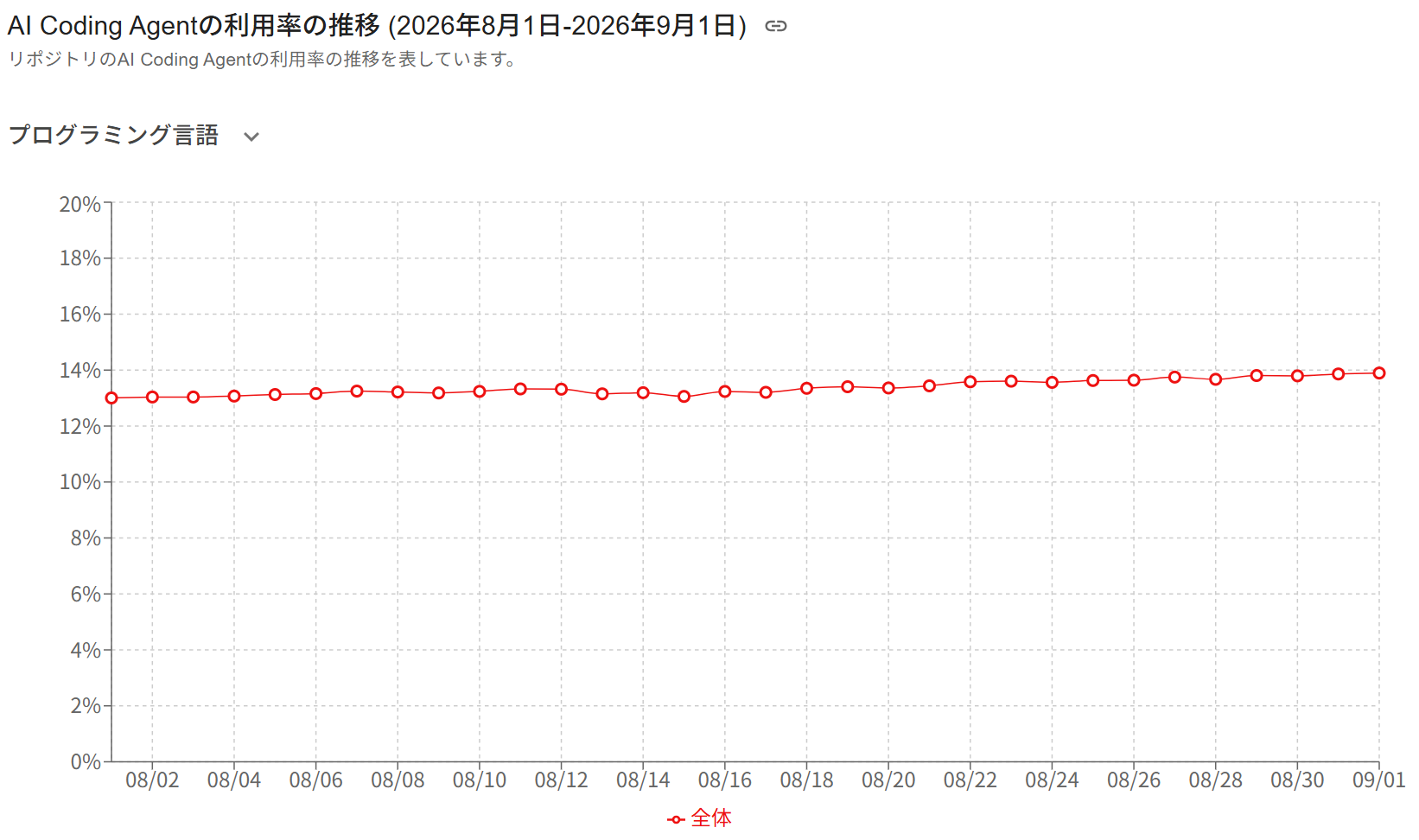
AI Coding Agent repository utilization rate was 13.9%, an increase of 0.9% from 13.0% last time.
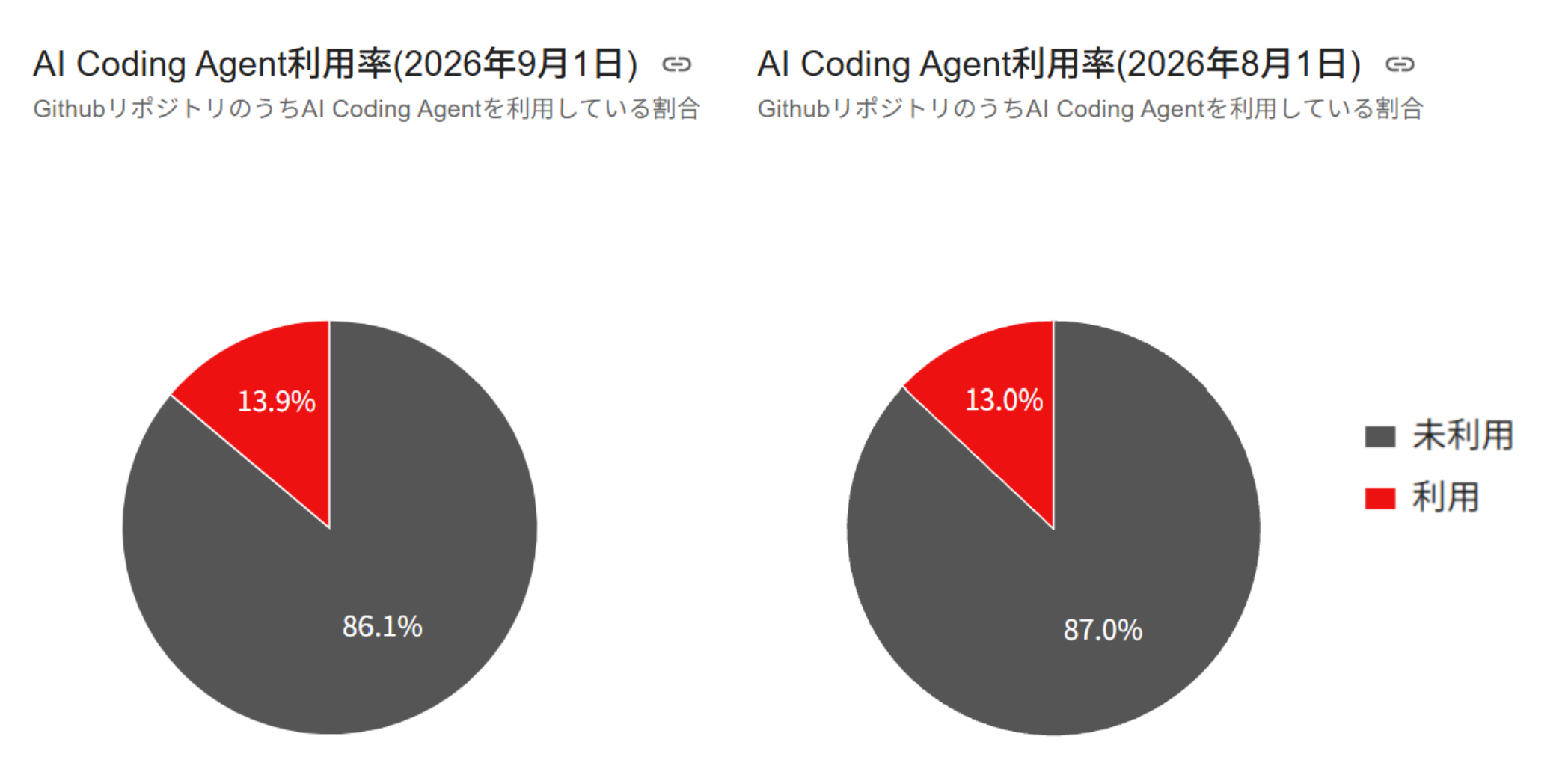
AI Coding Agent usage rate on September 1, 2026
https://ai-coding.info/?date=2026-09-01#adoption-rate
AI Coding Agent usage rate on 2026/8/1
https://ai-coding.info/?date=2026-08-01#adoption-rate
Trends in AI Coding Agent usage rate from August 1, 2026 to September 1, 2026
https://ai-coding.info/?date=2026-09-01&since=2026-08-01&until=2026-09-01#share-trend
Share of AI Coding Agent by product
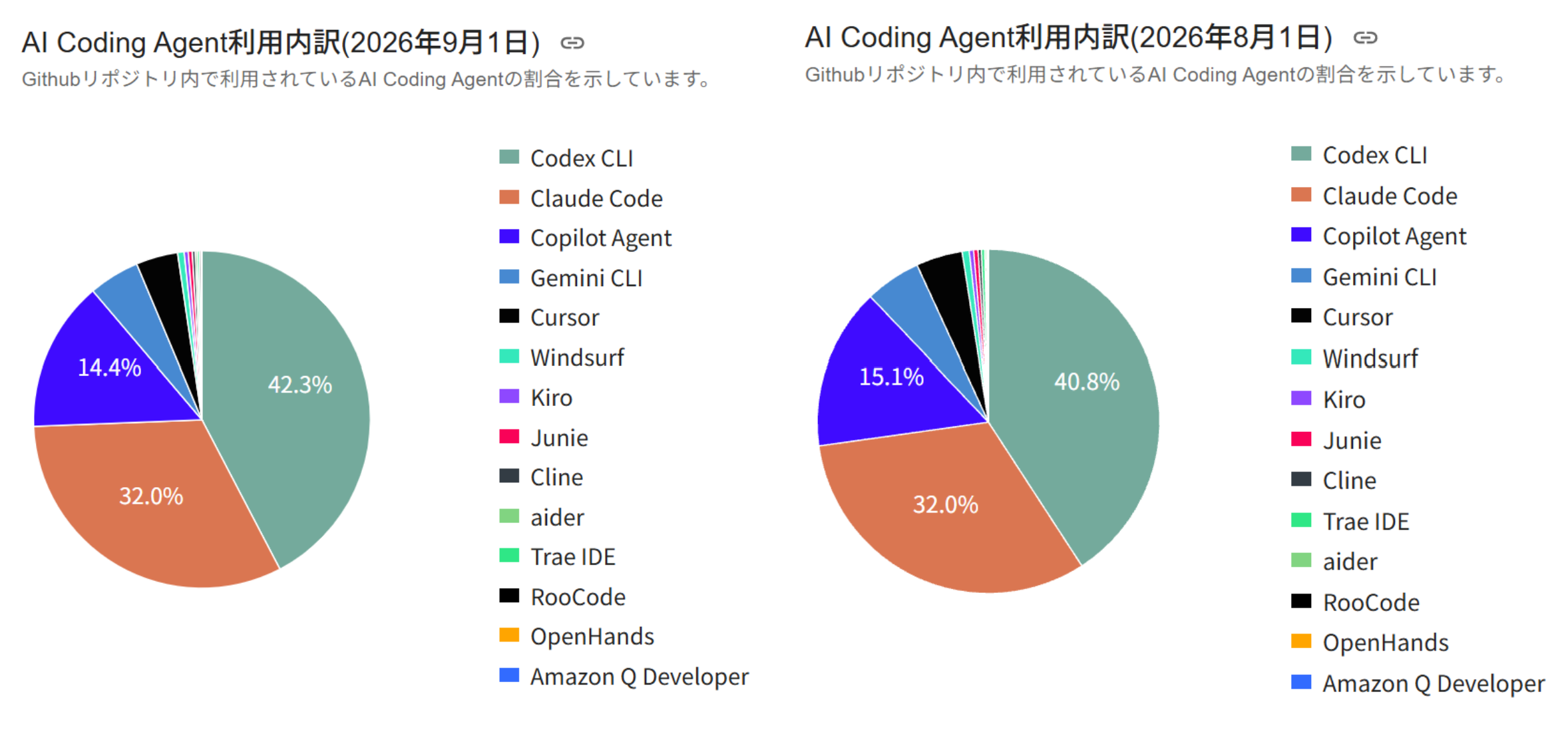
The share by product is as follows.
| Ranking | Product name | Share rate |
|---|---|---|
| 1st place | Codex CLI | 42.3% |
| 2nd place | Claude Code | 32.0% |
| 3rd place | Copilot Agent | 14.4% |
| 4th place | Gemini CLI | 4.9% |
| 5th place | Cursor | 4.0% |
AI Coding Agent share rate on 9/1/2026
https://ai-coding.info/?date=2026-09-01&since=2026-08-01&until=2026-09-01#agent-share
AI Coding Agent share rate on 8/1/2026
https://ai-coding.info/?date=2026-08-01&since=2026-08-01&until=2026-09-01#agent-share
AI Coding Agent usage status by programming language
The programming language in which AI Coding Agent is used the most is "TypeScript," the second is "Rust," the third is "Python," the fourth is "Go," and the fifth is "C#."
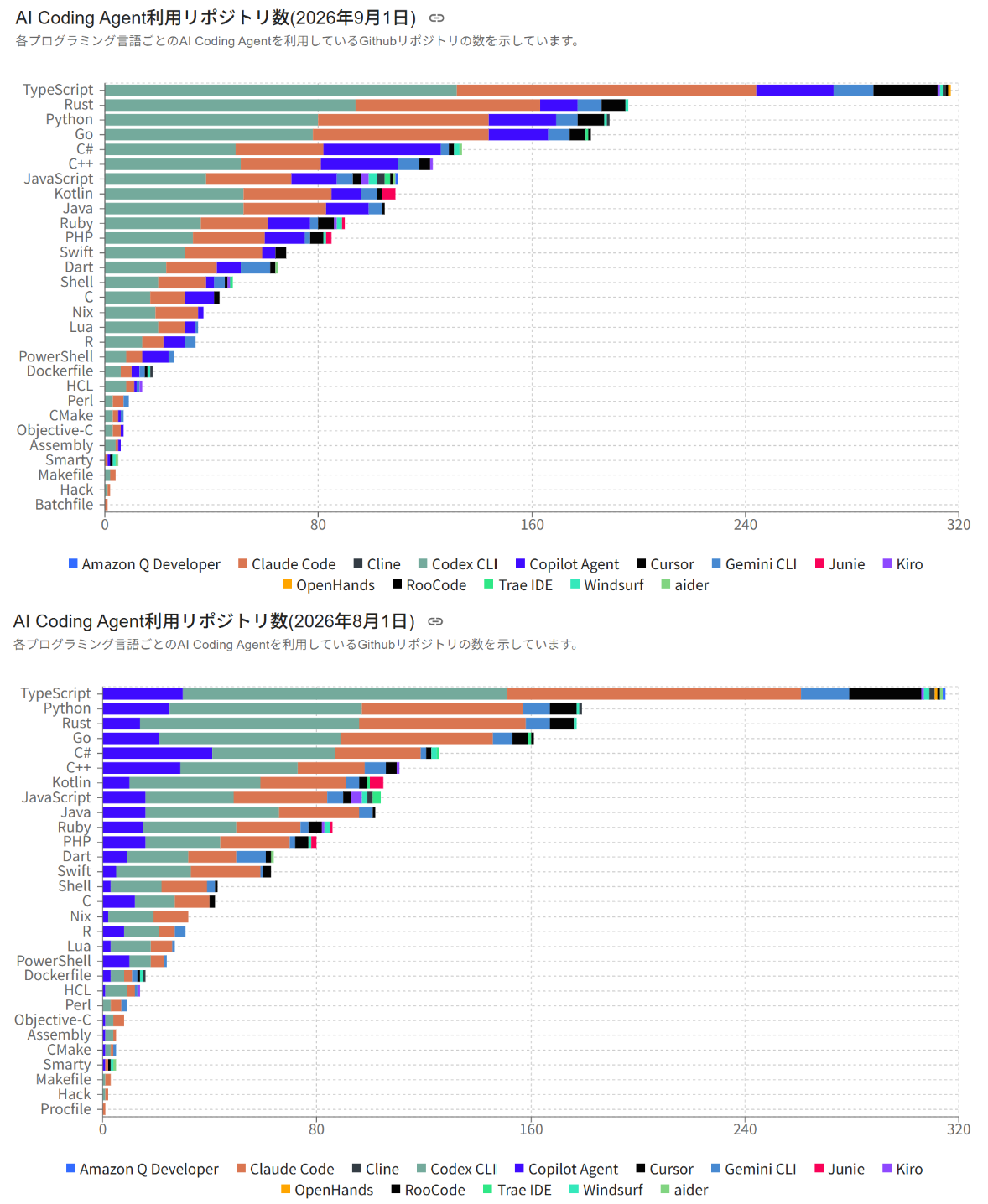
AI Coding Agent ranking by programming language on September 1, 2026
https://ai-coding.info/?date=2026-09-01&since=2026-08-01&until=2026-09-01#language-agent-rank
AI Coding Agent ranking by programming language on 2026/8/1
https://ai-coding.info/?date=2026-08-01&since=2026-08-01&until=2026-09-01#language-agent-rank
Monthly trends in the number of repositories used by AI Coding Agent
The number of repositories was 1,940 as of August 1, 2026, but has increased to 2,069 as of September 1, 2026, an increase of 129 repositories using AI Coding Agent.
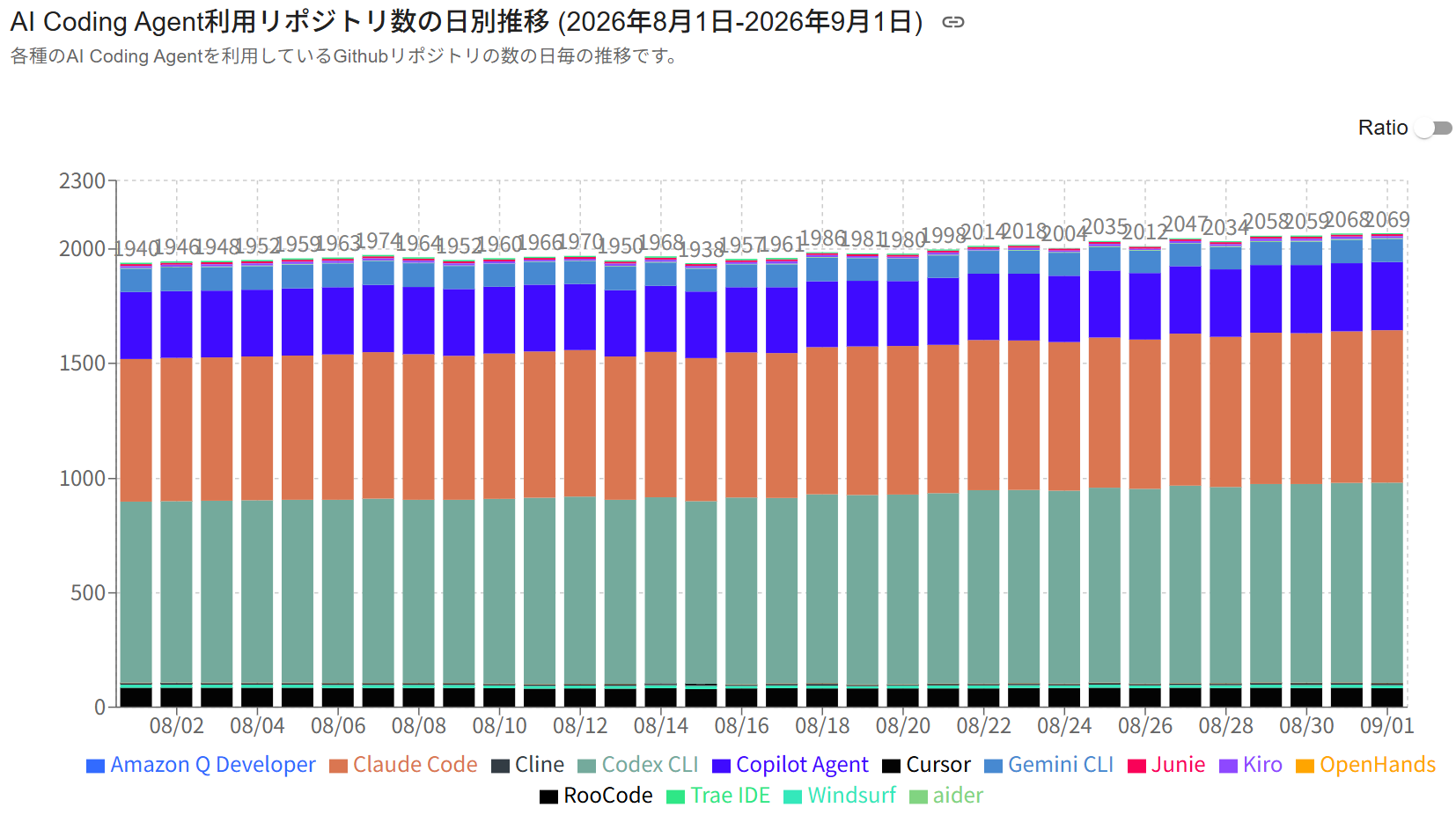
Changes in the number of repositories using AI Coding Agent from 2026/8/1 to 2026/9/1
https://ai-coding.info/?date=2026-08-01&since=2026-08-01&until=2026-09-01#time-based-bar-chart
Why smart glasses enthusiasts created AI Coding.Info
I usually share information about smart glasses on my YouTube channel called "Kotauchi Planning."
The PodCast "Kotauchi's Mirai's Glasses" is also updated every week.
We also publish a weekly article called ``World Smart Glasses News'' on note every week.
https://note.com/kotauchisunsun/m/mf522aa5d3efd
Why did such a person create a site to investigate usage trends of AI Coding Agent? This time, I will talk about how I started creating AI Coding.Info. At first glance, it seems like a different field, but the starting point was
"I want to streamline smart glasses software development with the power of AI"
That's what I felt. Around January 2025, I was developing software for LILYGO's one-eyed smart glasses called "T-Glass."
T-Glass is equipped with ESP32, and I was writing a program to run on it. At the time, I felt that the particular challenge was the time it took to build and write to the actual device. Even if you changed the program a little, you had to build it, write it to the actual machine, and check the operation. In my development environment, this whole process took time, making it difficult to increase the number of trial and errors. That's why I thought of a way to put the JavaScript engine "QuickJS" on top of the ESP32. There was already a precedent case where QuickJS was ported to ESP32, so I thought of using that.
https://qiita.com/binzume/items/f04d3b1b06cd0f7d3111
https://github.com/binzume/esp32quickjs
The idea is that if you first prepare an environment to run the script, then you can change the behavior by replacing the JavaScript code.
ESP32 can also connect to Wi-Fi. So, I wrote the code in TypeScript, which I usually use, transpiled it to JavaScript, and put it on the file server. We created a flow in which when you press a button on T-Glass, the Javascript code placed on the server is retrieved via Wi-Fi and executed using QuickJS. I was able to run this workflow itself.
If the change is on the JavaScript side, there is no need to build and rewrite the entire firmware. We were aiming for a development environment where we could repeatedly check on actual devices in a short cycle while utilizing TypeScript types.
Let AI “use one implementation as a model”
However, just because JavaScript works doesn't mean you can freely create smart glasses applications. For example, in order to operate the GUI from JavaScript, it is necessary to implement a bridge part that connects QuickJS and the C language side GUI library. To write this, I had to understand how QuickJS works, how to use GUI libraries, and how to pass values between JavaScript and C. At that time, AI wasn't that smart yet, so I tried implementing it myself, but it required a lot of knowledge, and it was quite difficult to extend similar processing to other functions. For this purpose, we utilized AI Coding Agent. At that time I was using Roo Code. First, I wrote a bridge part for one function, used it as a sample, and had the AI expand similar implementations to other functions. Instead of leaving everything to the AI, you can present the implementation policy and example yourself, and have the user proceed with the work accordingly. This development attempt ultimately did not lead to the completion of the entire concept. The reason is that Javascript and the C language have very different basic philosophies. For example, the use of pointers becomes a barrier. Even if you port the functions of LovyanGFX, a GUI library commonly used in the ESP32 series, as they are, they will become a bunch of pointers, so how should you handle them with Javascript? has become an issue. Therefore, just porting the functions of LovyanGFX was difficult to see in Javascript, and I think some kind of abstraction layer was needed. However, I felt there was great potential in being able to create a single implementation example and then increase the number of corresponding functions based on it. When developing software by yourself, instead of writing everything yourself, you can increase the number of parts that can be left to AI. To that end, I have come to believe that I need to continue learning about AI Coding Agent.
“What should I use” that changes every week
On the other hand, we also found it difficult to keep up with AI Coding Agent. At that time (early 2025), AI Coding Agents used as extensions of VS Code, such as Cline and Roo Code, were a hot topic. There were a variety of other options, including Devin and OpenHands, which I previously contributed to. Information about new tools and functions came out one after another, and it felt like the question of "what should I use right now" was being updated on a weekly basis. I myself was chasing information and trying out various tools, but I felt tired of continuing to do so. Also, even though I was able to try a popular tool, I didn't have a clear decision base as to why I should choose it. It is a composition that is being swayed by what is called an AI surprise shop. I want to choose the tools I use based not only on the announcement of new features or their reputation, but also on the actual situation. We wanted to use primary information as a basis for making decisions, not just marketing information. What I noticed was that
"Which AI Coding Agents are included in GitHub's public repositories?"
That's what it means.
Observe usage trends at fixed points as a basis for your own judgment
Then, AI Coding.Info was released in July 2025. We created a site to check whether there is a rule file used by each AI Coding Agent in the GitHub public repository and record the results every day. Of course, this method only determines whether the rule file is located in the repository. It does not measure the actual frequency of use or the quality of the generated code, and it does not capture cases where rules are used without a rule file. Even so, if you continue to observe using the same method, you will be able to see changes such as which tools are supporting more rule files, and which programming languages are being introduced more and more. Just because a tool is frequently used does not mean that it is the best tool for you. However, instead of just following the information that is flowing one after another, I thought that I could use the changes that I can see in the public repository as one of the things that will help me make decisions. Also,
I'm sure I'm not the only one who's tired of keeping up with AI information
I also felt that way. I also felt that by publishing the data I researched for myself, it might be helpful to others who are similarly confused about choosing a tool. AI Coding Agent is also used for the development of AI Coding.Info itself. The prototype was created in about two weeks, and since then we have continued to make modifications through trial and error. We continued fixed-point observation of usage trends, and about a year has passed since its release. Originally, what I wanted to do was not try out every new AI Coding Agent, but to efficiently develop smart glasses software by myself. For that purpose, I would like to receive support from AI. They also wanted information to help them decide which AI Coding Agent to use. Utilize AI to create software for smart glasses, and create AI Coding.Info as a basis for deciding which AI to use. This is why I, a smart glasses enthusiast, started creating this site.